Lawsuit over deed restrictions remains, prevents immediate construction
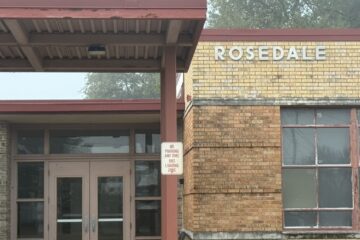
The Austin City Council has rezoned the former Rosedale Elementary School campus to permit construction of a 435-unit apartment complex.
The vote at the council’s Sept. 24 meeting was 10-1 in favor of the rezoning, which was proposed by the Austin Independent School District. (Watch a replay of the meeting.) AISD owns the 4.6 acre-site at 49th Street and Ramsey Avenue, which operated as a school from 1939 until it was shuttered in 2022.
The district, mired in a budget crisis, has a $26 million contract pending to sell to developer OHT Partners. The Austin-based developer proposes to build a six-story “Texas donut” luxury rental apartment building on the site.
Given the council’s highly pro-development tilt, the one-sided vote was expected. The council had postponed the rezoning vote in May to give the district, the developer and Play Fair With Rosedale a chance to negotiate a compromise. The parties met several times over the ensuing months, and moved toward each other, but failed to agree: The district wanted to maximize revenue; the neighborhood wanted to reduce impact.
Development battle shifts to courthouse
With the vote, the controversy shifts to the courts. The AISD contract will not be final — and construction cannot begin — unless the district nullifies deed restrictions owned by nearby homeowners.
In 1938, the original owners in the then-new subdivision signed documents that allowed the school to be built on some of the lots. In exchange, the school district vowed to restrict the property to school use. If the school system wants to do something else with the property, the deed restrictions snap back in, which explicitly limit development to “a residence” on “a lot.”
In October 2025, AISD sued 125 Rosedale neighbors, asking a judge to declare that a sprawling 435-unit complex is the same as “a residence” on “a lot.” That act sparked founding of the neighborhood group Play Fair With Rosedale. Play Fair and the Rosedale Neighborhood Association have opposed the development as too massive for a neighborhood of cottage homes and narrow streets.
Thus far, the sheer volume of defendants has snarled the progress of the suit; it is expected to come before a judge late this fall.
Neighborhood’s arguments
The council’s Sept. 24 vote to rezone the property should not impact the neighborhood’s legal argument.
At the council meeting, Play Fair With Rosedale representatives said they would welcome substantial development at the site, but not at this massive size.
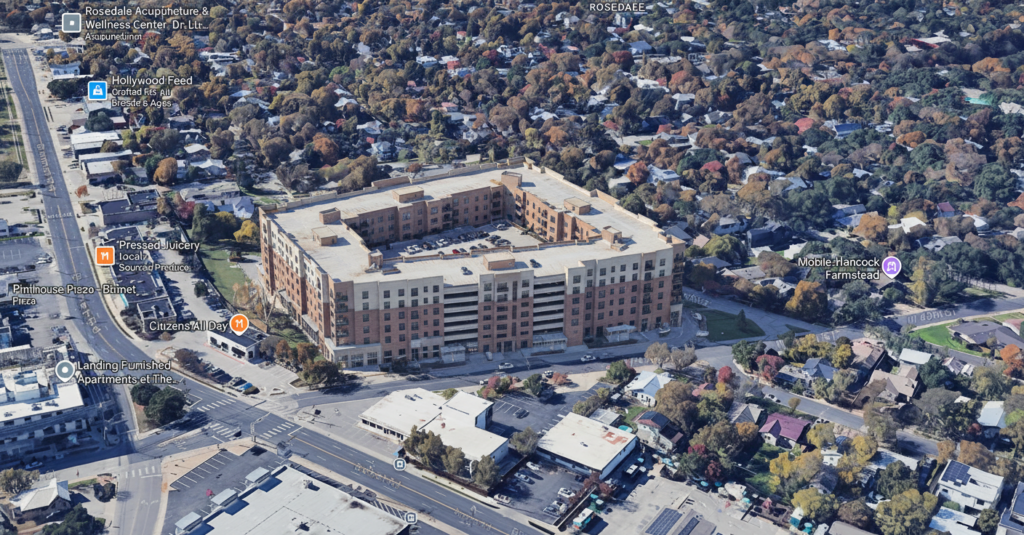
They argued the proposed development would:
- Overwhelm the already constricted intersection at Burnet Road and 49th Street. Drivers will avoid the bottleneck, causing traffic to flood the narrow, mostly sidewalkless neighborhood streets.
- Generate about 2,000 new vehicle trips per day, as much as one car every 30 seconds during rush hours.
Play Fair again presented an alternative view for Rosedale development, which would include more townhouses and garden-style apartments, in line with the council’s own policy encouraging that type of “missing middle” housing.
Council embraces developer’s view
OHT attorney David Hartman touted the benefits of the proposal to the council. It would, he said:
- Generate $10 million in tax revenue over 10 years.
- Provide some voluntary affordable units via a private restrictive covenant with HomeBase (Habitat for Humanity).
- Preserve a portion of the facade of the old school.
- Dedicate 1/2 acre of the site as a public park.
- Give the city about $600,000 in required street impact and park dedication fees.
The city’s planning staff recommended the proposal, which rezones the parcel from single family to high-density multi-family apartments (MF-6). The planning staff added a restriction that caps the height of the apartment complex to 75 feet.
Council flexes for housing, against neighborhoods
The council’s vote on Rosedale was in line with the council’s pro-development, pro-housing stance. At the same meeting, it voted to reject neighborhood objections to two other projects.
District 7 Council Member Mike Siegel represents northern Rosedale, including the school site. He voted against the wishes of all three neighborhoods, including those expressed by his own constituents. He had previously said publicly the lawsuit should play out before the zoning vote.
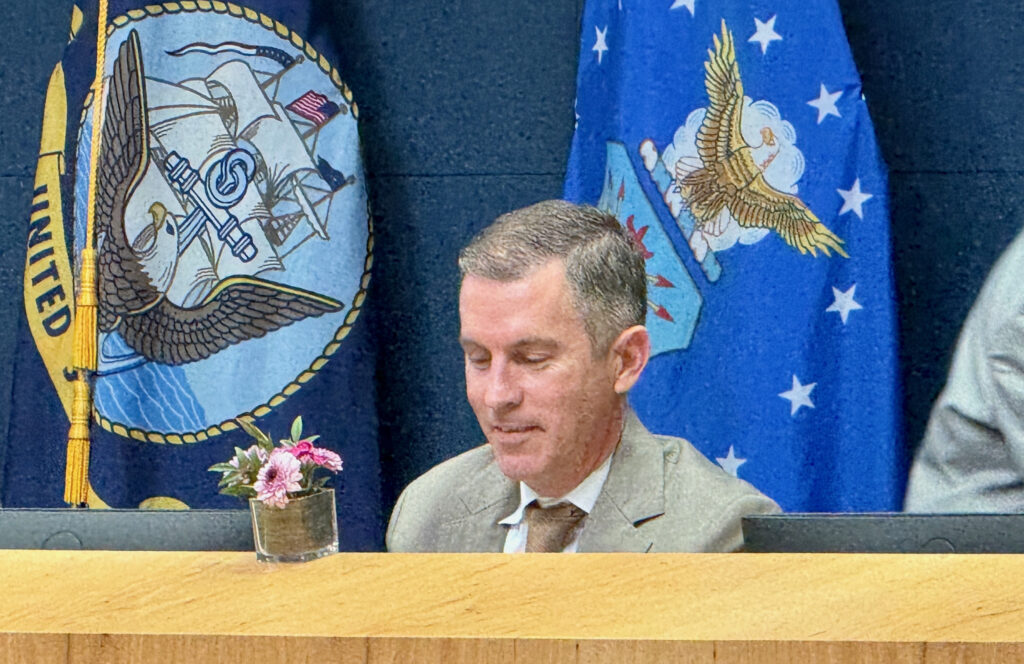
Let me make that clear today. Yes, I’m pro-housing.
Mike Siegel, District 7 Council Member
He said, “I’ve been asked several times over the last year, as this zoning case has progressed, ‘Aren’t you supposed to be a pro-housing council member? Why are you delaying approval of this case?’ And so, let me make that clear today. Yes, I’m pro-housing.” Even the neighborhood’s milder proposal would require an upzoning, he said.
Siegel said he still hopes a compromise emerges, but ultimately sided with helping the large-scale development proceed. “I would love for more people to be able to live in District 7 and to live in great neighborhoods like Rosedale,” he said.
District 10 Council Member Marc Duchen cast the only “no” vote. Duchen represents the southern part of the Rosedale neighborhood.
“If these apartments get built at the scale that I fear there are going to be traffic issues at 49th Street, and within the neighborhood itself,” he said. “And the case has strained a lot of public trust, in a number of ways.”
Duchen drew the council’s attention to the Anita Coy multifamily project under construction on a larger parcel owned by AISD in East Austin. There, the school district cooperated with the neighborhood, resulting in a project that incorporates affordable teacher housing, a resort-style pool, a fitness center, co-working spaces, and community lounges.
“I hope in the future we do see more Anita Coys and fewer Rosedales,” Duchen said.
Minor amendment
The council did add an amendment to the rezoning, at Siegel’s urging.
They directed City Manager T.C. Broadnax to look for ways to mitigate the traffic impacts, including the intersection at 49th and Burnet Road. The amendment is not binding, as it merely directs the manager to “consider” applying impact fees generated by this project toward fixing the traffic problems it creates.

0 Comments