A chronological look at the intertwined history of the old school and nearby residents
Welcome to the interactive timeline tracking the redevelopment of the former Rosedale School site. Tap the chronological tabs below to explore each phase of our community’s journey. The saga, from the original 1938 neighborhood deed restrictions to the ongoing legal and civic battle, has four parts:
- 1938-2020:
History - 2021-2023:
Promises - 2024-2025:
The sale - 2026+:
Court battle
April 1938: Rosedale H subdivision platted
The 21.5-acres subdivision is created with a strict covenant: “No lot … shall ever be used for any other purpose than that of a residence” unless written consent is granted by all lot owners within a 200-foot radius. In every land transaction in the neighborhood since then, homebuyers are notified they are protected by the deed restrictions.
Fall 1938: Land sold to Austin Public Schools
The school system gets permission from all owners within a 200-foot radius to acquire 20 lots for “erection and maintenance of a public school.” The agreement notes that in all other respects, original residential restrictions remain in full effect.
1939: School opens
The first phase of Rosedale School opens for the fall. It contains eight classrooms, an office, and a teachers’ lounge. Margaret Faubion is named principal, a post she will keep until 1966.
1946: School system buys more lots, expands school
The growing school system buys lots 13-21 for a Rosedale School expansion. It does not seek neighbor consent, acting on internal legal advice that consent was unnecessary if used strictly for public school purposes.
1948-1949: School’s use of natural lighting lauded
Rosedale Elementary classrooms undergo a $19,000 renovation to boost natural light, which a dynamic Texas education official Darrell B. Harmon has pioneered as a means to help students learn. An Austin American headline on the project reads, “Rosedale Lighting Draws National Attention.”

“Surroundings like these would make a teacher feel obligated to become a good teacher.”
— Rosedale Principal Margaret Faubion, 1948
1955: AISD formed
Austin Independent School District officially replaces Austin Public Schools, which had been managed by the city since 1881.
1960s-1984: Neighborhood-matched zoning set
City planners purposely assign SF-3 (Single Family) zoning to Rosedale and other elementary schools to cement them as integral, safe, low-traffic parts of the surrounding neighborhood footprint.
1970-1975: Pioneering desegregation figure serves as Rosedale librarian
As part of AISD’s “crossover” plan for desegregation, Algerene M. Akins Craig is transferred from her longtime post at Blackshear Elementary to Rosedale. Craig, the first black librarian in Austin and the first black member of the Travis County Historical Commission, was librarian at Rosedale until her retirement in 1975.
1980: Desegregation implemented
Austin schools fully integrate, 26 years after Brown v. Board of Education.
April 1981: Deed restrictions stop closure attempt
Over 200 neighbors pack the school auditorium where district officials air plans to shutter the school. Longtime Rosedale resident Maurine Morse waves the 1938 deed restrictions. AISD’s attorney concedes commercial sell-offs could be legally barred. The board backs off, keeps the site and eventually transitions it into a specialized school.
Jan. 1, 1984: Final nail in coffin of discriminatory deed restrictions
Rosedale’s 1938 deed restrictions, like many from the era in Travis County, contained racist language banning “any person of African descent” from buying a lot. Such language was declared unenforceable in court by a 1948 Supreme Court decision. Congress passed the Fair Housing Act in 1968 that barred new racist restrictions. But that left a loophole: private parties could still act on their pre-existing restrictions. Texas delivered the final blow with a property code update that went into effect Jan. 1, 1984. It declared all racist restrictions null and void.
1988-2020: A dedicated community haven
Rosedale campus serves as a vital specialized school for neurodiverse and medically fragile students aged 3–22.
September 2016: Austin adopts compatibility principles
City shares 12 core zoning principles emphasizing that land changes must preserve neighborhood character and offer smooth transitions between development intensities.
November 2017: Voters OK replacement funding
As the Rosedale School approaches its 80th birthday, Travis County voters bless a $1.05 billion bond program that includes $40 million for a replacement campus.
March 2021: Neighborhood proactively contacts AISD
As the replacement campus nears completion, Rosedale Neighborhood Association (RNA) opens dialogue with top school officials to check on the property’s fate.
July 2021: Real estate evaluation begins
School board hires a real estate consultant to review unused assets. Rosedale is flagged as one of the first three sites for community-engaged evaluation.
November-December 2021: Neighborhood assurances
The school district’s Chief of Operations Matias Segura tells neighbors he is unaware of restrictive deeds but stresses that AISD recognizes the campus as a “neighborhood asset.” The district plans to retain ownership of the land to protect it from unchecked commercial or residential development. (Segura becomes superintendent about a year later.)
January-February 2022: Community listening tours
AISD holds four repurposing meetings. Neighbors suggest keeping a public focus: teacher housing, senior housing, a community center, parkland, or a planetarium.
February 2022: Old campus closes
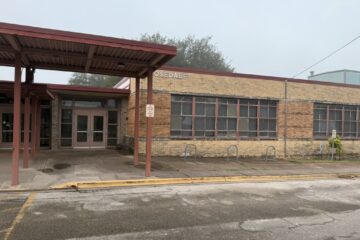
Rosedale campus shuts down after 83 years of service; students move to a new $50 million facility three miles north.
September 2022: Affordable staff housing stated as goal
AISD Real Estate Director Jeremy Stifler publicly states the district will not sell to the highest bidder but will remain a long-term partner. Scenarios range from 50 single-family homes to 44 townhomes and a four-story building.
September 2023: Low-density housing plan announced
AISD unveils a plan to build 50 single-family affordable homes prioritized for teachers, stating they “listened and heard” the neighborhood’s low-density preferences. The district’s “Repurposing Rosedale” presentation lists four goals. Its No. 1 goal “Retain ownership of the land.” The deal is described as being in the fourth of five phases.
November 2023: AISD postpones, then goes silent
Busy with other pressing matters, the district delays the project vote promising to “reconnect in early 2024.” Instead, communication ceases.
April 2024: The last friendly contact
The school system’s chief real estate officer, Jerry Striffler, provides a final brief neighborhood update reiterating the goal of district teacher homeownership opportunities, then cuts off neighborhood contact.
October 24, 2024: Surplus declaration
AISD’s Board of Trustees quietly declares the site surplus property “not required for educational purposes,” authorizing outright liquidation or ground lease.
December 17, 2024: RFP issued with revenue priority
The district issues a formal request for proposals. Marketing materials issued to prospective buyers declares that AISD is now interested solely in maximizing immediate cash revenue. The materials falsely advertise the parcel as “Burnet Road Frontage.” The marketing attracts 11 bidders.
February 2025: OHT proposes neighborhood-friendly development
One of the bidders, OHT Partners, submits a $23 million bid, and says it will build a 350-unit apartment building. While large, it promises to weave the five-story building around the site’s many trees, offer park space, and in general be a community asset.
March 2025: Superintendent authorized to sell to OHT
Citing severe budget constraints, Superintendent Segura abandons teacher housing. Striffler recommends OHT Partners, saying they have a “strong approach to working with the community.” AISD board unanimously approves the shift in priorities and the sale. It is the only time the elected board publicly discusses the drastic change in plans.
March-August 2025: Deal densifies behind closed doors
School officials negotiate with OHT behind closed doors. The builder’s initial 350-unit proposal morphs into a massive, 6-story, 435-unit “Texas Donut” luxury apartment block. All affordable housing is removed, buffer green spaces shrink, and the price tags climbs to $26 million.
August 12, 2025: The $26 million contract signed
Segura finalizes the contract. Crucially, the agreement mandates that AISD launch a lawsuit against its own constituents to break the 1938 deed restrictions.
September 2025: Rezoning fast-tracked
AISD submits applications to change the historical SF-3 neighborhood zoning to high-density multi-family.

October 9, 2025: Play Fair With Rosedale forms
Neighbors in close proximity to the school are notified of a zoning shift to MF-6-CO. In response, residents quickly organize, initiate fundraising, and retain attorney Renea Hicks.
October 31, 2025: AISD sues 125 of its constituents
Fulfillment of the sales contract. AISD serves legal papers to 125 local residents in Travis County Civil Court (Case D-1-GN-25-009749). The school district sued its own constituents to nullify the single-residence restriction.
December 2025: Demolition approved
The Austin Historic Preservation Board approves an application to raze the school site, securing only a soft promise from OHT to incorporate a portion of its distinct glass-block facade.
March 17, 2026: Zoning Commission recommends approval
Austin’s Zoning and Platting Commission votes 9-2 to back the high-density rezoning request.
April 2026: Rosedale creates alternative vision
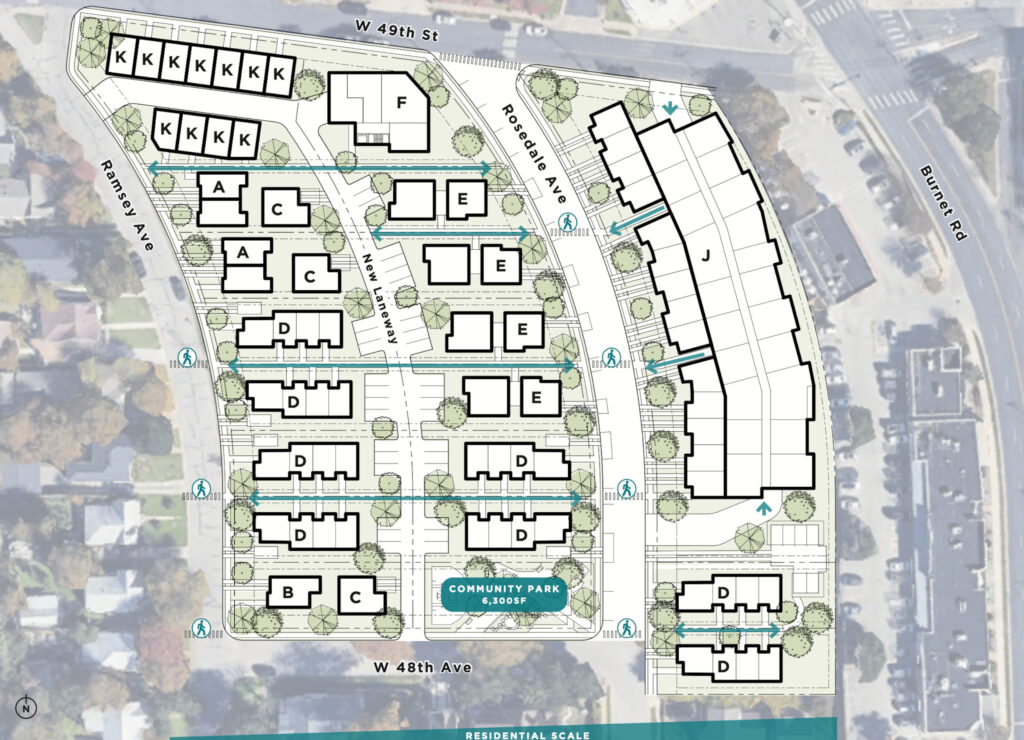
Play Fair With Rosedale representatives develop an alternative vision for building on the site that incorporates multiple styles of housing, but less dense than the OHT proposal. Neighbors continue organizing defense under attorney Renea Hicks. No trial date has yet been assigned in Travis County Civil Court.
May 7, 2026: First rezoning hearing before Austin City Council
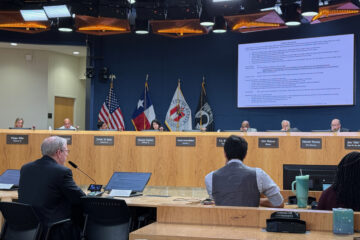
Lobbying by Play Fair With Rosedale results in a council vote to delay the vote until September to allow negotiations to take place between the neighborhood and AISD.
July-September 2026: Negotiation sessions, formal mediation
In an effort to reach compromise, representatives from the Rosedale neighborhood, AISD, and OHT meet multiple times. The talks culminate with a full-day formal mediation session chaired by Jeff Rose, former Chief Justice of the Texas Third Court of Appeals. Ultimately, the negotiations fail.
September 24, 2026: City Council passes rezoning
In a 10-1 vote, the Austin City Council changes the zoning to allow the 435-unit complex. However, the deed restriction lawsuit remains an active, unresolved barrier to actual construction.
October 2026: AISD hits defendants with 11,000 questions
AISD’s lawsuit against its constituents enters its discovery phase, where the parties exchange information. AISD plays hardball, issuing a massive, intrusive demand against 58 of the neighborhood defendants. The discovery fillings require individual answers to 193 queries. That’s roughly the length of a bar exam. Among other things, they demand homestead exemption records, property valuation documents, and to know who’s sleeping at your house.
Looking ahead …
September 2027: Contract deadline to close the deal
While the contract could be amended, the original deal between OHT and AISD set September 2027 as the deadline for the district to clear away the pesky deed restrictions and complete the transaction.
September 2029: Projected completion
OHT’s timeline targets final building completion.

0 Comments